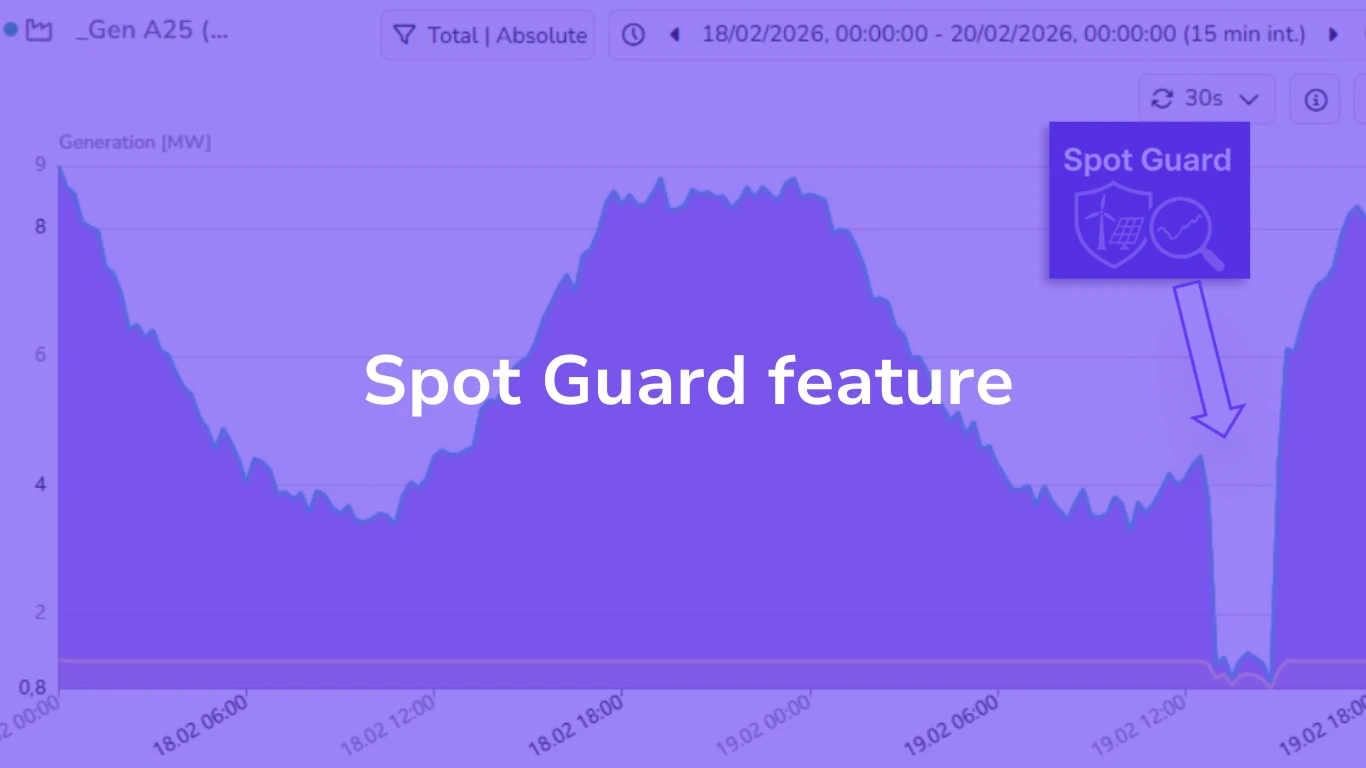
Electricity spot markets can create sharp price swings within very short timeframes. At CyberGrid we developed a Spot Guard feature, designed to help assets respond to that volatility, including avoiding generation when spot prices turn negative.
At its core, Spot Guard is a CyberNoc feature that calculates operating limits for assets based on market prices and asset-specific settings. Rather than acting as a full optimizer, it applies predefined logic: when prices cross configured thresholds, CyberNoc adjusts how much an asset is allowed to generate or consume. That makes Spot Guard especially relevant for operators who want a straightforward way to translate day-ahead market signals into asset control actions.
Spot Guard supports several practical use cases. On the generation side, it can curtail PV and wind assets during low or negative prices, helping avoid economically unattractive feed-in. On the consumption side, it can increase consumption when prices are low, which can be relevant for assets such as power-to-heat or some battery setups. It can also curtail consumption at high prices or increase generation at high prices, depending on the asset type and the selected activation mode.
Within CyberNoc, users can enable or disable Spot Guard, choose whether positive activation, negative activation, or both should be allowed, and map the required device attributes for sending activation signals and limits. This makes the feature flexible enough to fit different field-device setups.
It is vital to highlight what Spot Guard is not. It is not designed for assets simultaneously participating in balancing markets, and it is not intended to run alongside the co-location Flexibility Optimizer Agent (CFO Agent). For more complex BESS or co-located sites, the CFO Agent would be the more suitable solution.