As more energy assets are combined behind a single grid connection, flexibility becomes much harder to manage. A co-located site may include batteries, renewable generation and consumption, all operating under shared technical and grid constraints.
The challenge is no longer just controlling one asset. It is deciding, across the whole facility, when flexibility should be used on site and when it should be sold into the market. Co-located sites face sequential markets with different rules, uncertain forecasts, volatile prices, shared grid limits and asset-specific constraints such as battery state of charge, power limits, ramping behaviour or minimum renewable output. That is exactly the problem the Co-location Flexibility Optimization (CFO) Agent of CyberNoc is designed to solve.
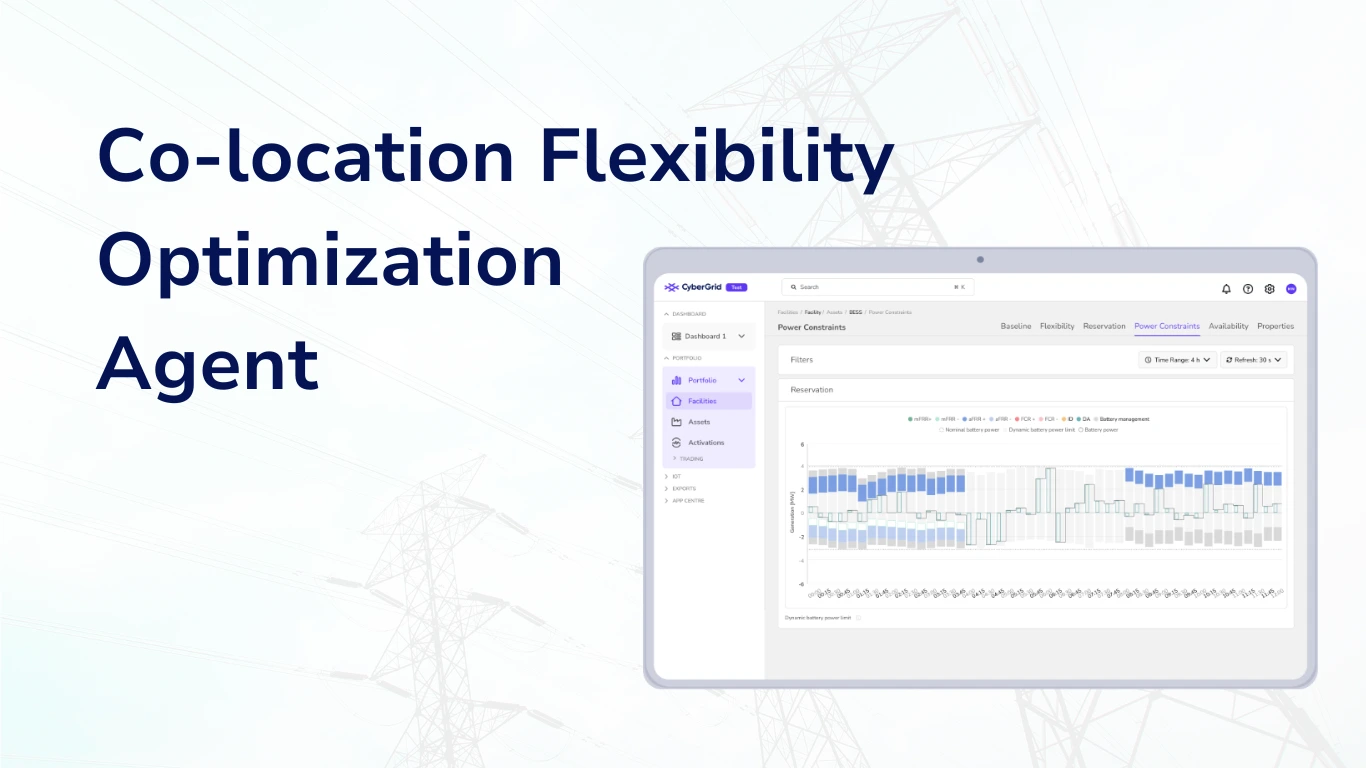
The CFO Agent is an optimization-based feature for CyberNoc that coordinates co-located assets at facility level. Instead of treating a battery, PV system or industrial load separately, it evaluates them as one system connected through one common grid connection point. This matters because every asset-level decision affects the others. A battery reservation for balancing services reduces what is available for on-site use. Flexible consumption can become a source of value when prices are low or negative. CFO Agent brings these interdependencies together in one decision framework.
The feature is built for cross-market energy trading. It supports coordinated participation across day-ahead, intraday and all balancing markets, while accounting for the opportunity costs between them. In practice, that means CyberNoc can evaluate not only whether a site should bid into a market, but also how much flexibility should be reserved, how much should remain available for the facility itself.
At its core, CFO Agent aims to minimize energy costs and battery wear while maximizing profit for the entire facility. To proceed with so, it considers market prices, flexibility forecasts, plant baselines, asset costs, and technical parameters such as battery efficiency.
Discover real case studies with co-located assets.