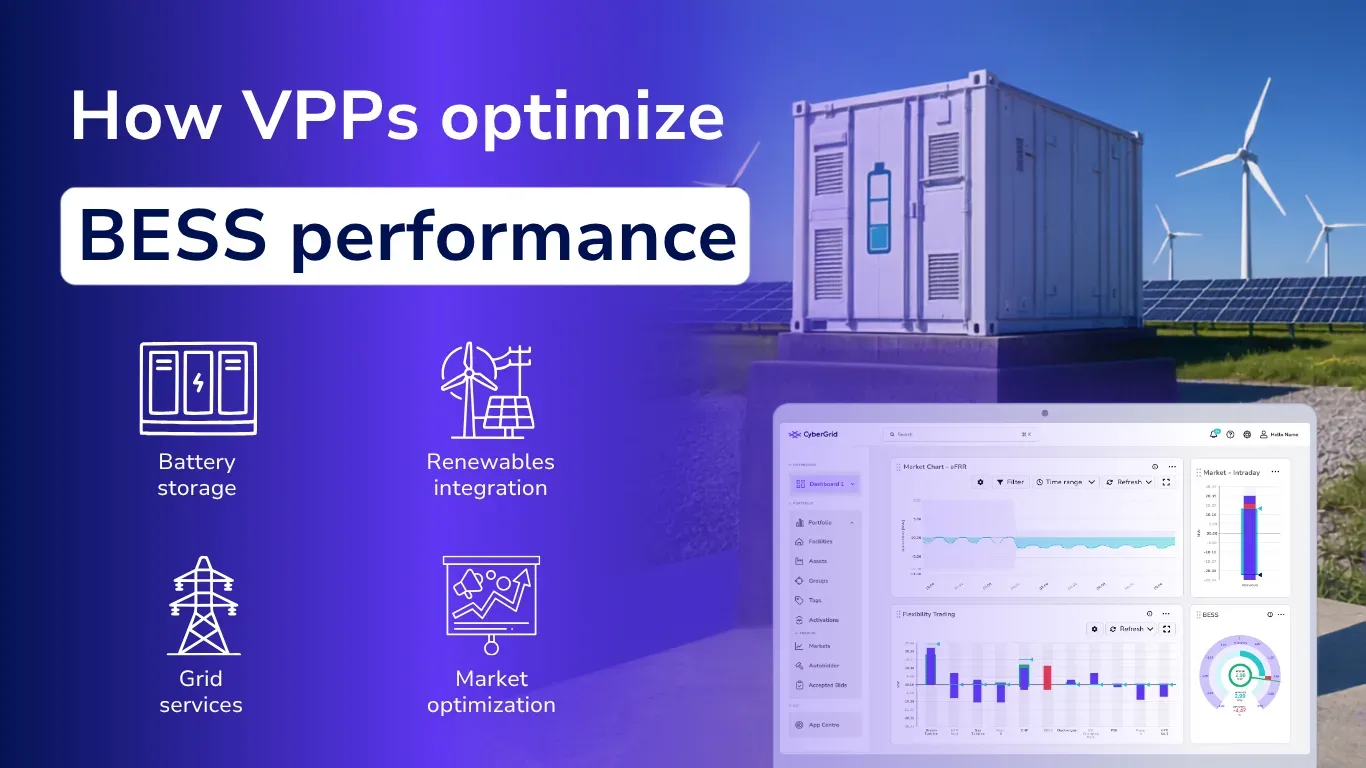
A Virtual Power Plant (VPP) optimizes battery energy storage system (BESS) performance by continuously coordinating state of charge, power limits, market commitments, degradation costs, forecasts and grid constraints. It determines when a battery should charge, discharge, reserve capacity or remain idle to maximize total asset value while maintaining technical availability and market compliance.
As electricity systems become more decentralized, VPPs connect and coordinate distributed energy resources, including batteries, solar PV, wind generation, EV chargers and flexible commercial or industrial loads, through one software platform. By aggregating these assets, a VPP can balance supply and demand, support grid stability and integrate more renewable energy, providing services comparable to those of a conventional power plant.
Batteries are particularly valuable because they can store electricity during periods of high renewable generation or low prices and discharge it when demand or prices rise. They can also provide fast-response balancing services, reduce renewable curtailment and generate additional revenue.
However, integrating a BESS into a VPP is more complex than managing a conventional generation asset. Operators must coordinate:
- state of charge, power and energy limits;
- charging and discharging efficiency;
- degradation, warranty and lifecycle requirements;
- balancing-service commitments and energy-market positions;
- co-located generation, flexible loads and grid connection limits;
- forecasts, technical qualification and regulatory requirements.
The objective is therefore twofold: maximize commercial value while preserving the battery’s ability to deliver contracted services.
How does a VPP improve BESS performance?
A VPP replaces isolated, reactive battery control with continuous, system-level optimization. Rather than deciding only whether a battery should charge or discharge, it evaluates multiple factors simultaneously:
- current and forecast electricity prices;
- battery state of charge, available power and efficiency;
- reserved balancing capacity and expected activation energy;
- grid import and export limits;
- renewable generation and consumption forecasts;
- degradation costs and contractual obligations.
Based on these inputs, the platform calculates the most valuable technically feasible operating strategy. BESS performance should therefore be measured not only by energy traded, but by the total net value generated after energy costs, imbalance exposure, efficiency losses, degradation and operational restrictions.
How can a BESS participate in multiple energy markets?
A BESS can create value across:
- day-ahead and intraday markets;
- FCR, aFRR and mFRR;
- local flexibility mechanisms;
- ancillary and congestion-management services.
Participation depends on local market design, asset qualification and regulatory requirements. Because all markets compete for the same limited battery power and energy, capacity allocated to one service is unavailable to another. A VPP uses cross-market optimization to allocate battery power and energy to the combination of markets that produces the highest expected net value.
Real-time and sequential market optimization
The VPP platform continuously updates the BESS schedule as forecasts, market prices, asset conditions and contractual positions change. Because energy markets close at different times, optimization must also reflect their sequence. A decision made in the day-ahead market affects the flexibility that remains available for intraday trading and balancing services.
Opportunity-cost evaluation
Every battery commitment has an opportunity cost. The VPP compare the expected value of using capacity in one market against the value that could be earned by reserving it for another. A market with the highest visible price is not necessarily the most profitable option after activation probability, energy costs, degradation and alternative revenue opportunities are included.
Capacity reservation
The VPP platform reserves sufficient battery power and energy for contracted services before allocating the remaining flexibility to additional market opportunities.
Portfolio-level optimization
The VPP solution optimizes the total portfolio rather than treating each battery or market independently. A lower-value decision for one individual interval may create a higher overall portfolio result by protecting future flexibility or enabling another asset to participate more profitably. The objective is therefore not to maximize revenue from a single market. It is to maximize risk-adjusted portfolio value across all eligible markets while respecting battery, site and contractual constraints.
CyberGrid developed the Co-location Flexibility Optimization Agent for our state-of-the-art software, which is designed specifically for coordinated participation across day-ahead, intraday and balancing markets. It evaluates opportunity costs, determines how much flexibility can be offered and reserves capacity for facility-level requirements.
How does a VPP solution coordinate a battery with PV, wind and flexible loads?
VPP optimizes an entire facility as one interconnected energy system, coordinating:
- batteries, renewable generation and flexible consumption;
- shared grid import and export limits;
- generation and load forecasts;
- charging, discharging and market activation;
- curtailment and on-site energy costs;
- capacity allocation across markets.
For example, the VPP may charge the battery with excess solar generation that would otherwise be curtailed. It may instead preserve battery capacity for balancing services when their expected value is higher. During negative-price periods, the platform may increase battery charging or flexible consumption and reduce uneconomic renewable exports. During high-price periods, it may discharge the battery, increase generation or reduce flexible loads within technical and contractual limits.
CyberGrid’s CFO Agent evaluates batteries, renewable generation and flexible consumption as a single facility behind a shared grid connection. It therefore accounts for how each asset-level decision affects every other asset.
Why Is VPP Optimization Essential for BESS Performance?
Battery flexibility does not automatically translate into commercial value. Without coordinated optimization, a BESS may reach its energy limits during balancing activation, commit capacity to conflicting services, miss better opportunities, cycle for insufficient revenue, breach grid limits or operate independently from co-located assets.
VPP optimization converts battery flexibility into controlled, market-ready and commercially valuable performance. By coordinating state of charge, market participation, degradation, forecasts, co-located assets and grid constraints, a VPP can increase availability, reduce operational risk and maximize total portfolio value. The result is not simply more charging and discharging, but better battery operation across the full asset lifecycle.