Austria is geographically well located and interconnected with the neighbouring countries via the European electricity system, thus facilitating cross-border trading. The electricity market liberalized on 1 October 2001, vertically integrated several companies instead of having a monopolistic structure. The energy market is comprised by several market players, such as:
- Control area operators (CAOs)
- Imbalance settlement responsibles (ISRs)
- Transmission system operators (TSOs)
- Balancing responsible parties (BRPs)
- Distribution system operators (DSOs)
- Suppliers
- Generators
- Electricity wholesalers, retailers and traders
Therefore, the Austrian wholesale electricity market is open to generators, traders, retailers, and large consumers, who can trade on both day-ahead and intraday markets to sell and buy electricity according to their short-term supply and demand needs. In this way, market players can manage their energy portfolio as well as step forward and efficiently control price volatility. Likewise, they can manage real-time imbalances between electricity supply and demand via the balancing market, while ensuring grid stability.
Share of renewable energy and main green targets
Electricity final consumption in Austria continuously increased reaching now 71.57 TWh, which represents more than a 50% increase in comparison to 1990 (IEA, 2023)1. On the other hand, total CO2 emissions have decreased until 57.32 Mt, which is only 1.92% more than in the 90s. During the first decade of the 21st century, the amount of CO2 emissions was higher reaching a maximum of 74.45 Mt in 2005 (ibid.).
The industry sector is the one that consumes more electricity reaching 98 093.0 TJ in 2020; followed by residential; commercial and public services; transport; and agriculture and forestry (IEA, 2023)2. The electricity consumption per capita has reached 8.4 MWh in 2021, according to the same data source.
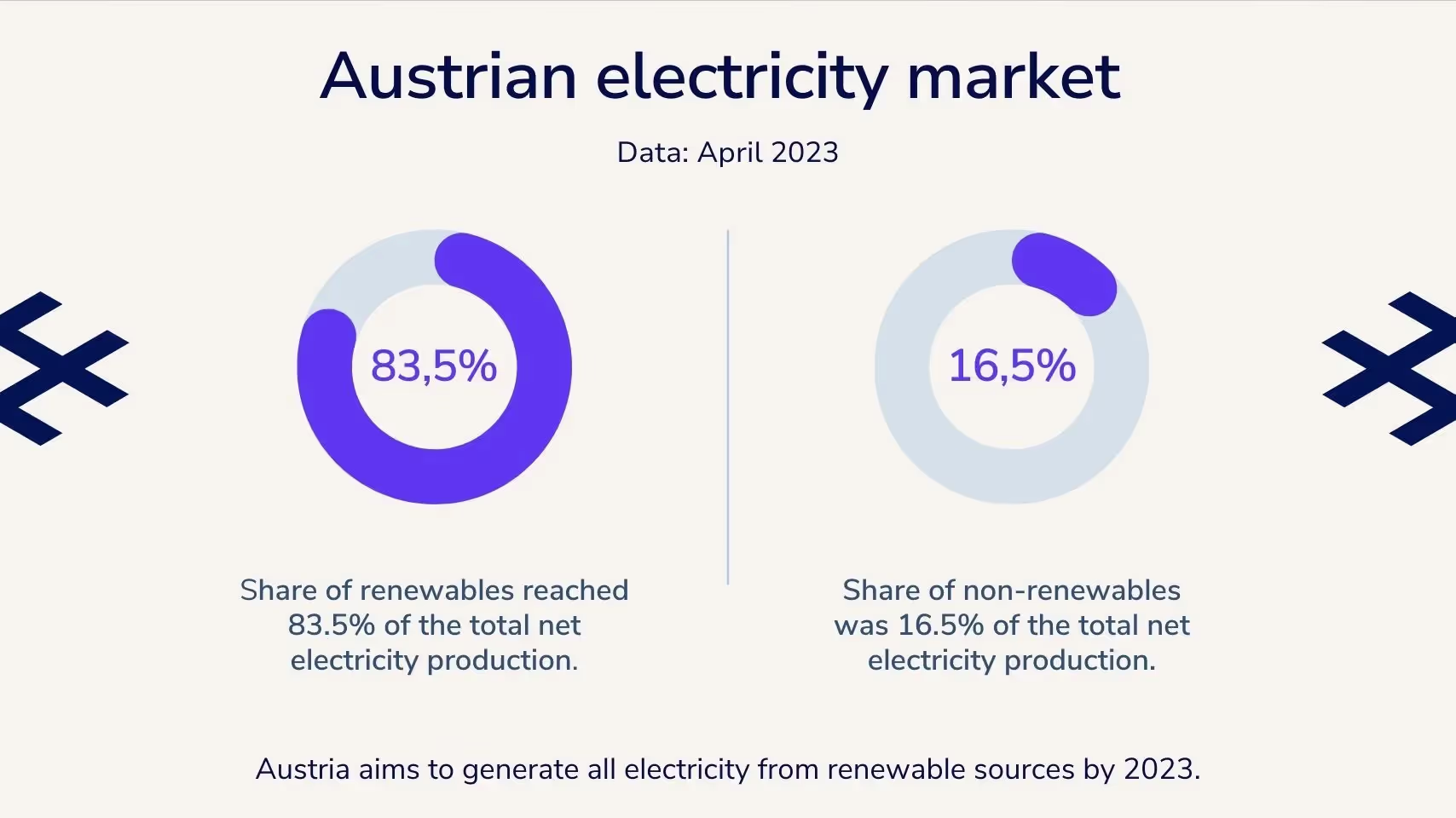
In the Austrian electricity market, the share of renewables reached 83.5% of the total net electricity production in April this year, which corresponds to 4 951.8 GWh; while the non-renewables’ share was 16.5% or a total value of 976.3 GWh, which is a 22.7% downturn in comparison to the previous year (IEA, 2023)3.
Austria aims to generate all electricity from renewable sources by 2023, as stated under its National Energy and Climate Plan. The country aims to increase green electricity production by 27 terawatt hours (TWh) until the mentioned year, as stated in the Renewable Energy Expansion Act (E-Control, 2021: 6)4. Specifically, 11 TWh shall come from PV, 10 TWh from wind, 5TWh from hydro, and 1TWh from biomass (ibid.). Austria also committed to achieve the 55% target reduction in CO2 by 2030 and climate neutrality by 2040.
Actually, the country has a highly reliable electricity supply network thanks to the diversified mix of energy sources. Austria’s power output is comprised by a 4% solar, 10%wind, 14% natural gas and biomass, and between 55% and 67% of hydropower (Edwardes-Evans, H. 2023: 14)5.
1 & 2 IEA (2023). Austria data explorer.
3 IEA (2023). Monthly Electricity Statistics.
5 Edwardes-Evans, H. (2023). EIB agrees to co-finance EVN's Austrian 103-MW wind program. S&P Global Inc. Power in Europe. Issue 897. pg.14