As renewable generation, battery energy storage systems (BESS), and demand-side flexibility become increasingly important components of the electricity system, market participation has also become more complex. Asset operators, utilities, and aggregators often participate in multiple electricity markets simultaneously, including day-ahead, intraday, balancing, and ancillary service markets.
To manage this complexity, many organizations rely on Virtual Power Plant (VPP) platforms that aggregate distributed energy resources and automate market participation. These platforms combine forecasting, optimization, bidding, and real-time asset control to coordinate a portfolio across multiple markets and time horizons.
New challenges for market participants
Traditionally, power trading focused on a limited number of generation assets and market products. Today, energy companies must manage portfolios consisting of renewable generation, battery storage, industrial loads, and flexible consumers. At the same time, market opportunities have expanded.
Operators may participate in:
- Day-ahead electricity markets
- Intraday markets
- Frequency Containment Reserve (FCR)
- Automatic Frequency Restoration Reserve (aFRR)
- Manual Frequency Restoration Reserve (mFRR)
- Other ancillary service and balancing products
Each market has its own gate closure times, technical requirements, bidding rules, and settlement mechanisms. As a result, determining the most profitable allocation of flexibility across markets has become a highly data-driven task.
For larger portfolios, manually evaluating all possible market opportunities can quickly become impractical. Modern optimization systems therefore use automated algorithms to evaluate market opportunities, forecast asset availability, and create bidding proposals across multiple markets simultaneously.
How electricity market bidding works
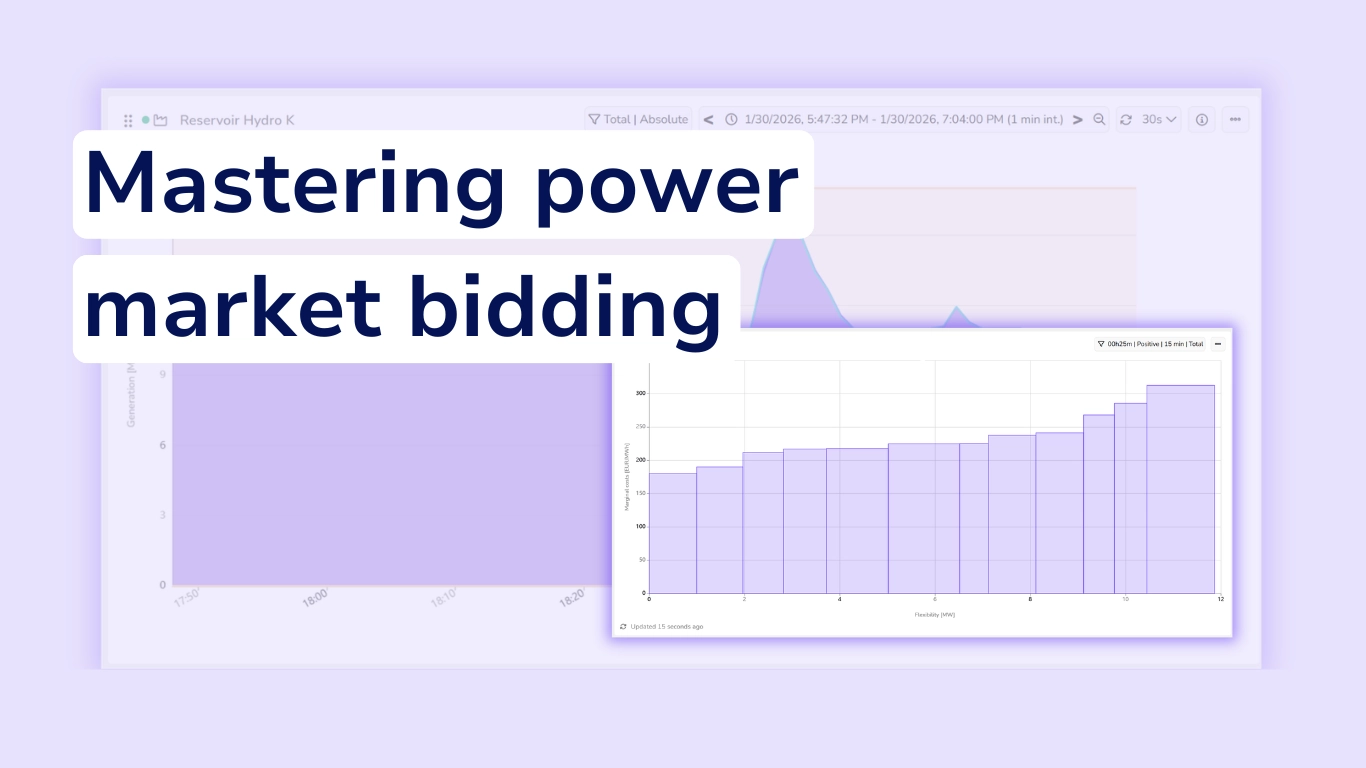
In competitive electricity markets, participants submit bids and offers that specify both a quantity of power and a corresponding price.
Once the bidding window closes, the market operator evaluates all submitted bids and determines a market-clearing price that balances supply and demand. Bids and offers that fall within the cleared volume are accepted, while those outside the clearing range are rejected.
The role of accepted bids differs depending on the market:
- Day-ahead markets: accepted positions are delivered on the following day.
- Intraday markets: participants can adjust positions closer to real time as forecasts change.
- Balancing and ancillary service markets: accepted bids provide flexibility that helps maintain system stability and frequency control.
Because market conditions can change rapidly, participants often need to monitor accepted positions across multiple products and delivery periods throughout the day.
Why accepted bids matter
Accepted bids are more than just a trading outcome. They directly affect operational planning, financial performance, and regulatory compliance.
Revenue and cost visibility
Accepted bids determine the revenues earned from energy delivery and capacity reservation, as well as any associated costs. Understanding which positions have cleared and at what price provides transparency into expected cash flows and portfolio performance.
Delivery obligations
Once accepted, bids become binding commitments. Asset operators must ensure they can deliver the contracted energy or reserve capacity. Failure to fulfill these obligations may result in imbalance costs or other market-related penalties.
Performance analysis and strategy improvement
Historical bidding results provide valuable insights for improving forecasting, optimization, and trading strategies. By analysing bid acceptance rates and clearing prices, market participants can better understand market dynamics and refine future bidding behaviour.
Managing accepted bids in large portfolios
Monitoring accepted bids becomes increasingly challenging as portfolio size grows. A portfolio may contain dozens or hundreds of distributed assets participating across several markets simultaneously, creating a large volume of transactional and operational data.
To maintain transparency, traders and portfolio managers require tools that consolidate market information into a single view. Typical requirements include:
- Visibility of market positions across all supported markets
- Asset-level and portfolio-level schedules
- Capacity and energy market commitments
- Revenue tracking and settlement information
- Backup capacity requirements for reserve provision
- Historical analysis of bidding performance
Visual dashboards, data analytics, and automated reporting help translate market activity into actionable operational insights.
From market clearing to portfolio visibility
Modern VPP and flexibility management platforms provide a structured overview of the bidding lifecycle, from bid creation and submission through approval, acknowledgement, and acceptance.
A comprehensive bidding dashboard typically enables users to:
- Review submitted capacity and energy bids
- Monitor accepted market positions
- Track obligations for ancillary service provision
- Analyse expected revenues and settlement outcomes
- Filter data by time period, market, or asset type
Users can generally distinguish between:
- Capacity bids: where remuneration is received for reserving flexibility capacity.
- Energy bids: where remuneration is linked to actual energy activation or delivery.
Handling increasing data volumes in short-term markets
The growing importance of short-term electricity markets presents a new challenge for market participants. Products traded in 15-minute intervals, combined with rolling auctions and continuous trading, generate a significant volume of market data.
This is particularly evident in intraday and balancing energy markets such as aFRR energy, where trading decisions and position updates occur close to real time.
To support operational decision-making, accepted bids are typically imported directly from market platforms through automated interfaces. Many market participants also maintain alternative import methods to ensure business continuity during maintenance periods or temporary interruptions of market APIs.
As electricity markets continue to evolve, the ability to interpret, monitor, and optimize accepted bids will remain a key capability for utilities, aggregators, and flexibility providers seeking to participate effectively in increasingly dynamic energy markets.